Application
Admission is open to all bachelor’s degree holders, aiming academic or professional career and interested in furthering their education through a program of individual study in architecture and urban design.
Required application materials are:
1- Statement of Interest (A personal statement explaining goals and objectives for the program,description of the intended field of study, research or design project based on Istanbul and its relation with the main theme of the studio)
2- Current resume (CV) and creative portfolio
3- English Language Proficiency Test Result
Participants will be able to join the program without paying any contribution fee.
Given the individualized nature of the Academy’s program, there are a limited number of spots available each semester, so we suggest early applications.
The language of the program is Turkish and English. Besides the studio, seminars, conferences and events are mostly held in Turkish. The applicants are expected to have sufficient knowledge in English to be able to read, discuss, research and present their studies. All applicants whose native language is not Turkish or English must submit YDS (min 65), TOEFL IBT (min 70) or IELTS (min 6.0) score for admissions.
The program is offered free of charge to all participants. However, participants traveling from outside Istanbul are responsible for their own accommodation and transportation.
2026 / Spring Semester
Application Deadline: 2 March 2026, Monday (23.59, GMT+3)
Interview Date: 7 March 2026, Saturday (10.00-18.00)
Program Start Date: 9 March 2026, Monday
Program End Date: 28 June 2026, Sunday
During the semester, seminars, lectures, and public events will be held in person at AURA Istanbul’s center in Beşiktaş. Participants will engage in a dynamic program structure that combines studio work, discussions, and thematic sessions, while continuing their academic or professional activities alongside the program.
The core of the Academy’s program is the Research-Based Design Studio. For the Spring 2026 semester, projects will be developed around the theme “Urban Transformation in Istanbul: A Transdisciplinary Perspective” under the guidance of studio advisors Tansel Korkmaz and Cem Çelik. The studio will be supported by a series of seminars, case-study discussions featuring invited practitioners and researchers from diverse disciplines.
Applicants are expected to outline a research-based design proposal within the framework of the studio theme, in their statement of intent.
The application deadline is March 2, 2026 (23:59 GMT+3).
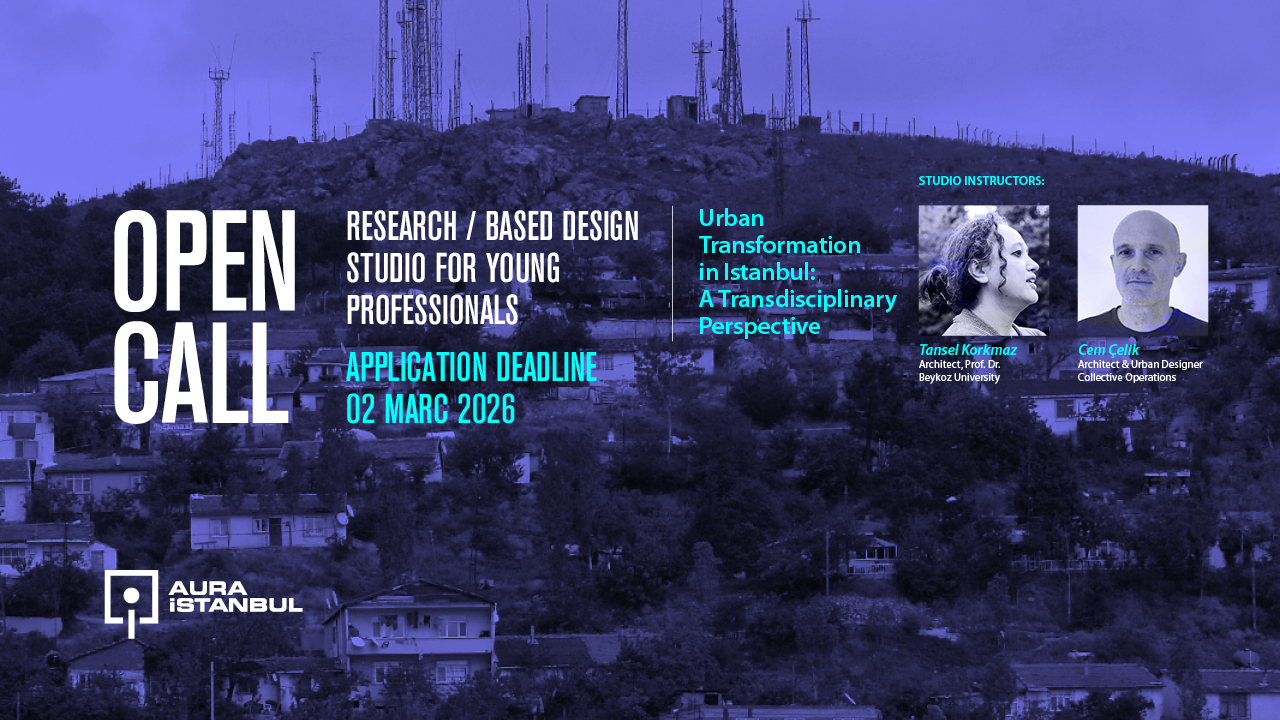
RESEARCH-BASED DESIGN STUDIO
“Urban Transformatıon ın Istanbul: A Trans-dıscıplınary Perspectıve“
The Age of Crises describes a moment of profound upheaval. On the one hand, we are becoming increasingly aware that we are driving our planet toward ecological collapse; on the other, we are witnessing the disintegration of the “global order” constructed by modernity. Even the exciting promises of artificial intelligence and robotics are accompanied by concerns about mass unemployment, pervasive surveillance, and new forms of control in everyday life. Yet this uncertain and unsettling period also holds the potential for new beginnings. To navigate these transformations, we must develop ways of thinking and acting that can engage productively with uncertainty. Like all disciplines, architecture must fundamentally reassess its methods and assumptions in response to the spirit of our time. But, how?
As Wallerstein suggested, “the end of the world as we know it” signals not only collapse but also the threshold of renewal. The making of a new world cannot proceed through the Faustian model of domination that shaped the past. We are now confronted with the consequences of placing humanity at the center, treating nature as an exploitable resource, and consuming it without restraint. We have come to understand that every act of damage inflicted on nature is ultimately damage to ourselves; we are not masters of nature but part of it. From this perspective, architecture must establish a radically different relationship with the earth. Rather than a practice defined by constant conquest and assertion, architecture must be reimagined as a care praxis, a mode of thinking and making that is attentive, reparative, and complementary to what already exists. In this framework, the Studio investigates the possibilities of such an approach, engaging thoughtfully with all living and non-living systems as well as with the built environment we inherit.
Istanbul stands as one of the most vulnerable metropolises of this Age of Crises. It must urgently transform into a city that is ecologically, economically, and socio-culturally resilient while also confronting the pressing reality of earthquake risk.
Attempting transformation at this scale and speed through conventional approaches risks producing new ecological damage and, in some cases, becoming an instrument of dispossession. The Studio therefore frames the potential transformation of the earthquake-vulnerable neighborhoods of Gülsuyu and Gülensu as a transdisciplinary research inquiry, exploring how these areas might evolve into communities that are self-sufficient while remaining dynamically connected to their wider urban context.
- The work begins by situating the study area within Istanbul’s metropolitan structure and analyzing its existing values with care, repairing what has been fragmented or degraded rather than replacing it wholesale. It asks whether transformation can be imagined through alternative programs such as new models of social housing, commons-based spatial practices, and urban agriculture, through the use of alternative materials including enhanced earth-based construction, and through different techniques of making. In short, the Studio will ask whether another, place-specific architecture of transformation is possible.
- The Studio also investigates the historical layers of the area, its origins and moments of rupture, while conducting and documenting oral histories with residents. By mapping the socio-economic geography of the neighborhood, it examines the possibilities and limits of participatory processes and explores alternative economic models that could support transformation.
- The documentation of everyday life, alongside the recovery of past records, to build a collective visual archive.
- Exploring the relationship between public space and art by engaging with the site’s cultural and social layers. Through participatory, site-specific contemporary art practices that connect with local memory and daily life, it seeks to understand how cultural production itself can become a tool of urban transformation.
Understanding Urban Transformation: Transdisciplinary Perspectives
This seminar series aims to develop a transdisciplinary framework in order to grasp the multilayered nature of Istanbul’s urban transformation processes and to generate comprehensive approaches:
Ali Faruk Göksu
Ayşegül Cankat
Defne Akşin Akyol
Ela Kaçel
Emrah Altınok
Erdoğan Yıldız
Fuat Ercan
Gül Köksal
Güzin Konuk
İlhan Tekeli
Korhan Gümüş
Murat Cemal Yalçıntan
Murat Güvenç
Postane & MAD (Mekânda Adalet Derneği)
Ünal Akkemik
Architecture and Urban Design: Case Studies
In the Case Studies sessions, architects present and critically reflect on their own work: housing, social housing, commons, productive landscapes…
Aslıhan Demirtaş
Boğaçhan Dündaralp
Bünyamin Derman
Can Çinici
Cem Çelik
Cem İlhan
Cem Sorguç
Devrim Çimen & Sertaç Erten
Ece Emanetoğlu
Han Tümertekin
Nevzat Sayın
Ömer Selçuk Baz
Özgür Bingöl
Zeynep Altınbaşlı & Tuna Han Koç
STUDIO INSTRUCTORS
Tansel Korkmaz
Tansel Korkmaz Bilgin graduated from the Department of Architecture at Middle East Technical University in 1986. She completed her master’s and doctoral degrees at the same institution and began her academic career there in 2000, first as a research assistant and later as a lecturer.
She was a founding member of the Tepe Architecture Culture Center, established under the leadership of Prof. Dr. Haluk Pamir, and of its affiliated publication, XXI Architecture, Design and Art Magazine. Until 2004, she taught courses in the Department of Communication at Istanbul Bilgi University and served as a studio instructor at Yıldız Technical University.
In 2005, under the leadership of İhsan Bilgin, she joined the founding team of the Graduate Architecture Program at Istanbul Bilgi University, followed by the founding team of the Faculty of Architecture established in 2009. In 2021, she was appointed Acting Founding Dean of the Faculty of Art and Design at Istanbul Kent University, and in 2024, she joined the Department of Architecture at Beykoz University.
Her teaching, seminars, and publications focus primarily on modern and post-modern architectural history, theory, and criticism, as well as contemporary architecture in Turkey. In 2007, she was awarded a fellowship from the Aga Khan Program and served as a visiting researcher at Harvard Graduate School of Design, Department of Landscape Architecture. During this period, exposure to studios led by Carl Steinitz and seminars by scholars such as Richard T. T. Forman expanded her research interests to include urban design and the relationships between urban and rural ecosystems.
She has led graduate and undergraduate design studios on these themes in collaboration with Cem Çelik and Samet Mor.
Cem Çelik
Cem Çelik completed his Bachelor of Architecture in 1999 at Mimar Sinan Fine Arts University, and received his Master of Architecture in Urban Design (MAUD) from Harvard University Graduate School of Design in 2001. He has been a registered member of the Chamber of Architects of Turkey (UIA Turkey) since the same year.
With nearly three decades of professional experience spanning architecture, urban design, real estate development, and construction, he has worked extensively across Europe, Asia, and the United States. His work ranges from large-scale urban regeneration projects to bespoke residential developments. In 2009, he founded Collective Operations, where he leads projects through an integrated and holistic design and development approach.
Between 2001 and 2006, Çelik worked as an urban designer at EDAW/AECOM in the New York, Hong Kong, and Shanghai offices. During this period, he served as lead designer for the Tianjin Hai River Revitalization Project, contributing to a comprehensive urban transformation along an 8 km river corridor.
From 2006 to 2010, he served as Managing Director of Capital Partners in Turkey, overseeing the establishment and development of the 5 km² Kaplankaya coastal settlement. Concurrently, as a partner at BOD&COO, he led key projects including the Rizzo and Kamondo developments in Istanbul, as well as the Renaissance Hotels and Kazinvest Bank Headquarters in Kazakhstan.
His built work includes the Kaplankaya Masterplan, Six Senses Residences Phase 2, Kaplankaya Private Villas, Teos HiddenBay Residences (İzmir), Tienshan Gardens Residences (Almaty), the adaptive reuse and restoration of NO25, Kamondo, and Rizzo buildings in Galata, as well as a range of private residences in Turkey and abroad.
Alongside his professional practice, Çelik has remained active in academia, serving as Director of the Advanced Design and Research Studio in the Graduate Architecture Program at Istanbul Bilgi University, where he co-led studios with Tansel Korkmaz focusing on the urban complexities of Istanbul.